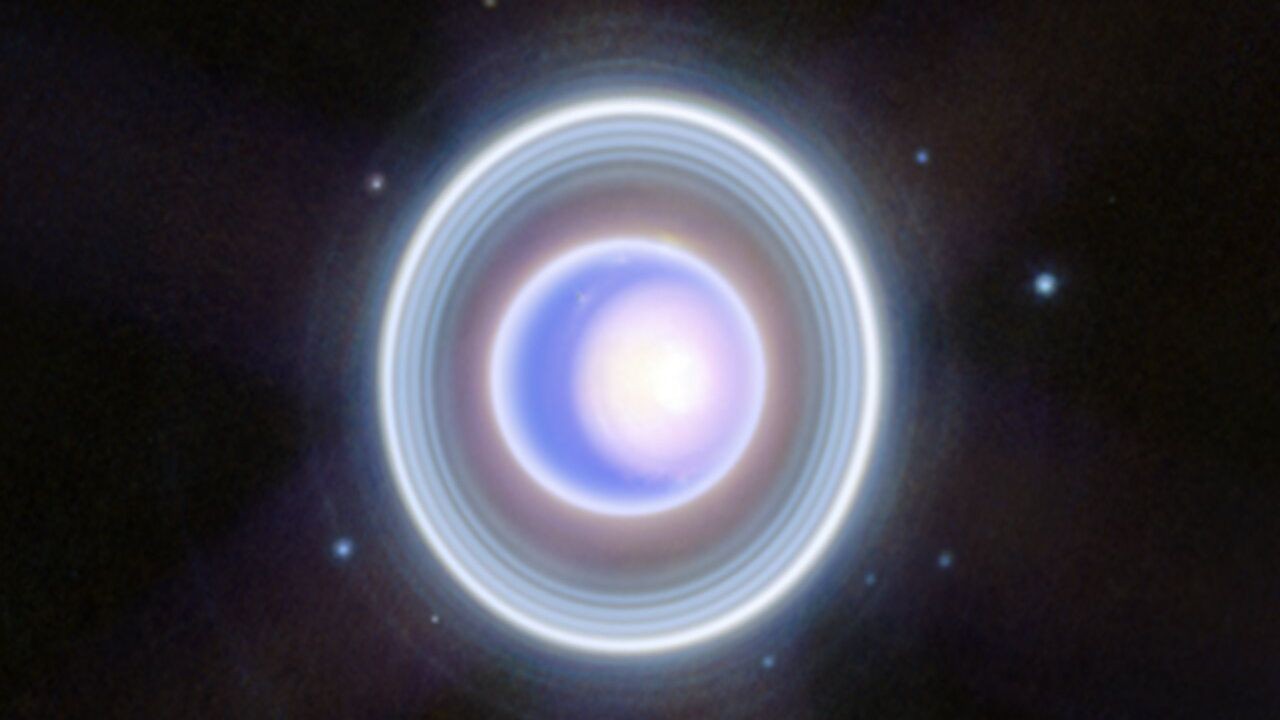
New data from the James Webb Space Telescope (JWST) has revealed that the ring system of Uranus is far more complex than previously imagined. By analyzing how sunlight reflects off these faint rings, astronomers have discovered that the outermost rings are composed of vastly different materials, suggesting they are fed by entirely different types of moons—some of which remain undiscovered.
A Tale of Two Rings: Blue Ice vs. Red Dust
Unlike the brilliant, massive ring system of Saturn, Uranus’s rings are thin, faint, and difficult to detect. For decades, astronomers have struggled to understand their composition. However, by combining infrared data from the JWST with older observations from the Hubble Space Telescope and the Keck Observatory, researchers have finally been able to “decode” the light reflecting off these structures.
The study highlights a striking contrast between the two outermost rings, known as the mu ($\mu$) and nu ($\nu$) rings:
- The Mu ($\mu$) Ring: This ring appears blue, a color that indicates it is composed of very small particles of water-ice. Researchers have traced this material back to a small, 12-kilometer-wide moon named Mab.
- The Nu ($\nu$) Ring: In contrast, this ring has a red tint, signaling a composition of fine dust. It contains 10% to 15% carbon-rich organic compounds, typical of the cold, outer reaches of our solar system.
The Mystery of Divergent Origins
The fundamental question facing astronomers is why these two rings, located in the same planetary system, are so chemically distinct.
The mu-ring’s icy nature is reminiscent of Saturn’s E-ring, which is fueled by geysers on the moon Enceladus. However, while most of Uranus’s inner moons are thought to be rocky and dusty, the moon Mab is surprisingly icy. This discrepancy raises new questions about the formation and evolution of the Uranian system.
Regarding the nu-ring, scientists believe it is being continuously replenished by “unseen rocky bodies.” These undiscovered moonlets are likely being bombarded by micrometeorites, causing organic-rich dust to be “sputtered” off their surfaces and into orbit.
“By decoding the light from these rings, we can trace both their particle size distribution and composition, which sheds light on their origins,” says Imke de Pater of the University of California, Berkeley.
The Search for a Future Mission
While these findings provide a clearer picture of what the rings are made of, they also highlight how much we still don’t know. There are subtle changes in the brightness of the mu-ring that scientists cannot yet explain, and the presence of “unseen” moons suggests that the 29 currently known moons of Uranus are only part of the story.
Because these rings and moons are so small and faint, ground-based telescopes and even the JWST can only provide indirect evidence. To truly solve the mystery of why these parent bodies are so different, astronomers argue that a dedicated spacecraft mission is required.
Fortunately, there is hope for a closer look. Returning to Uranus was named the top planetary priority in the most recent Decadal Survey by the National Academy of Sciences, meaning a future mission may be on the horizon if funding is secured.
Conclusion
The discovery of vastly different compositions in Uranus’s outer rings suggests a complex, diverse system of moons that current technology can only observe from a distance. These findings underscore the need for a dedicated mission to explore the ice giant and its hidden satellites.