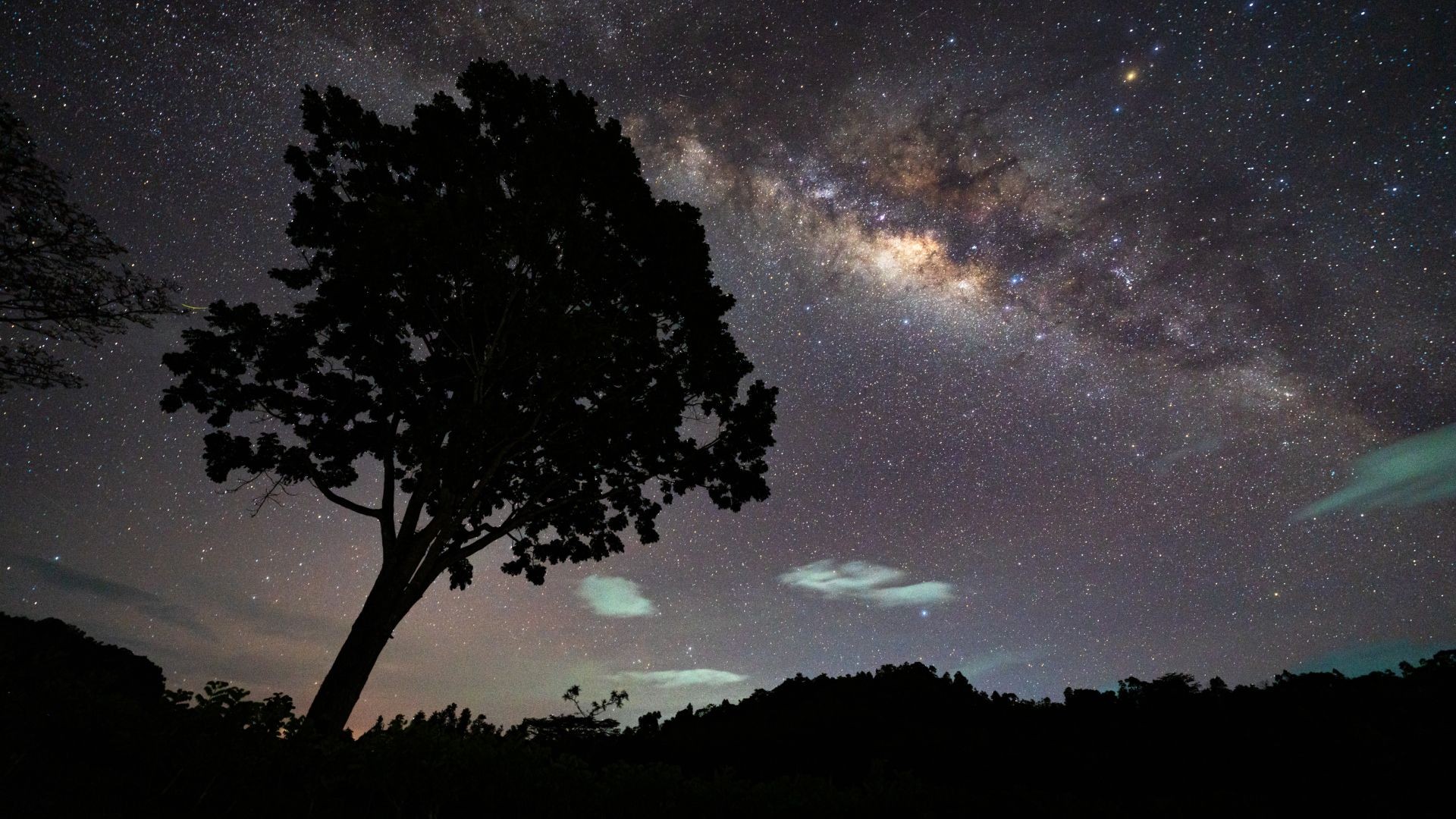
The arrival of the new moon on April 17, 2026, marks a premier window for astronomers and casual stargazers alike. Because the moon will be positioned between the Earth and the Sun, its illuminated side will face away from us, leaving the night sky in near-total darkness.
For those interested in astronomy, this “moonless” period is a rare gift. Moonlight acts as a form of natural light pollution; when it is absent, the subtle glow of distant galaxies and faint constellations becomes visible to the naked eye and through even modest equipment.
Evening Viewing: Planets and Star Clusters
As the sun sets on April 17, the western horizon offers a dense collection of celestial targets:
- Venus: Appearing as a brilliant “evening star,” Venus will sit approximately 15 degrees above the horizon.
- The Pleiades: Just 10 degrees above Venus, this famous open star cluster will be highly visible.
- Uranus: Located slightly below and to the left of the Pleiades, this ice giant is too faint for most naked-eye observers. However, using binoculars or a small telescope will reveal it as a distinct, tiny greenish disk.
Looking higher into the sky, Jupiter will dominate the overhead view. Positioned below the bright stars Castor and Pollux in the constellation Gemini, Jupiter offers a spectacular sight through a telescope. With at least a 6-inch aperture, observers can see the Galilean moons —Io, Ganymede, Europa, and Callisto—lined up like bright beads alongside the planet.
Pre-Dawn Opportunities: The Planetary Triangle
If you prefer early mornings, the period before sunrise on April 18 provides a unique geometric alignment in the eastern sky. A “planetary triangle” will rise in the dawn glow:
- Mars will hold the highest position in the grouping.
- Saturn will sit below Mars.
- Mercury will appear to the right of Saturn.
- Neptune will also be visible to the upper right of Mercury, though it requires specialized equipment to detect due to its extreme distance.
Exploring the Deep Sky and Constellations
The dark skies of mid-April are ideal for identifying large, sprawling constellations that are often washed out by moonlight.
The Great Serpent and the Lion
The southern sky is currently dominated by Leo the Lion. Look for the “sickle” shape of stars that forms the lion’s head, anchored by the bright star Regulus.
Extending from this region is Hydra, the largest constellation in the night sky. While Hydra lacks the dazzlingly bright stars of other constellations, its massive scale is impressive once located. Along its “back,” you can find the smaller constellations Corvus (the Crow) and Crater (the Cup), positioned near the bright, blue-white star Spica in the constellation Virgo.
Deep-Space Targets
For those equipped with telescopes, the intersection of Leo, Virgo, and Coma Berenices offers a journey through deep space. By locating the stars Denebola (the tail of Leo) and Vindemiatrix, observers can find Markarian’s Chain. This is a stunning sequence of galaxies that can be viewed with modest amateur equipment, offering a glimpse into the ancient history of the universe.
Observer’s Tip: To maximize your experience, seek out “dark sky” locations away from city lights. This reduces terrestrial light pollution and allows the faint light of galaxies and distant planets to reach your eyes more clearly.
Summary: The April 2026 new moon provides a rare, dark-sky window that makes planets like Jupiter and Venus, the massive constellation Hydra, and distant galaxy chains like Markarian’s Chain exceptionally easy to observe.