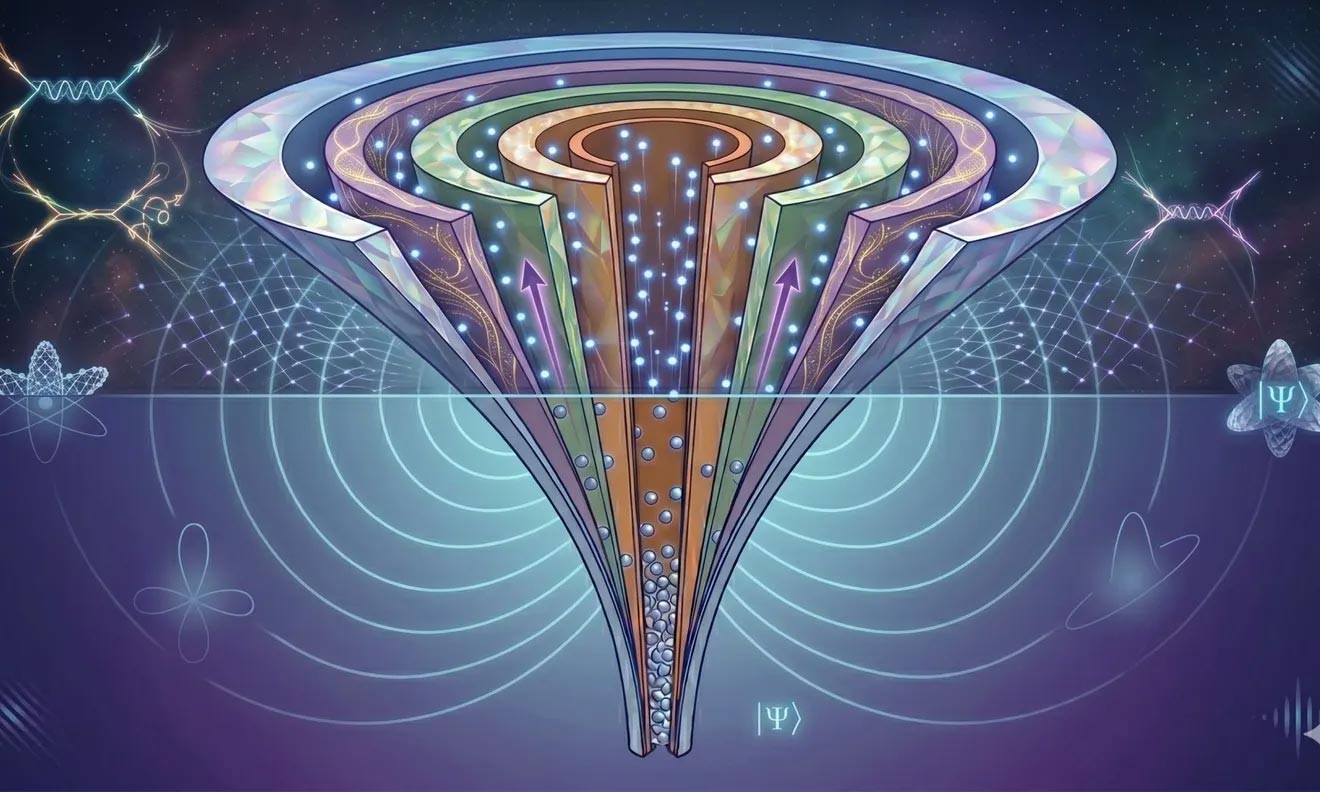
Scientists built a ghost phase of matter. Not one nature hands us freely. One they had to coax, cycle, and twist into existence. It is called a fractional Fermi sea.
Engineering the impossible
Forget equilibrium. The standard rulebook for ultracold atoms usually points to the Tomonaga-Lutting liquid theory. It is the sturdy workhorse for describing 1D quantum systems. But the team, led by the Nägerl group with theory from Alvise Bastianello (CNRS and Université Paris-Duphine), wanted to see what happened off-road.
They took cesium atoms. Locked them in a single dimension. Then they tortured them with interactions.
By repeatedly flipping the atoms between strong repulsion and deep attraction, they kept the system running in a cycle. A heartbeat of force. Far from the comfort of thermal balance, the atoms didn’t just get hot and messy. They reorganized.
Quantum engineering in action. You don’t just find these states in a jar. You have to design the path to them.
What even is this thing?
Usually, fermions stack neatly into energy states. That is the Fermi sea. Textbook stuff. Bastianello asked a simpler, sharper question: What happens if you force those interacting atoms to cycle through extremes?
The result? A state that is highly excited but surprisingly rigid. The particles obey a “fractional” occupancy rule. Fewer particles claim a given space than standard stats predict. It feels wrong. It looks right.
Yi Zeng, lead author, cuts through the noise. “Instead of simply heating the system, the interactions reorganize the atoms.” It is not chaos. It is a controlled escape from equilibrium.
The hidden signature
How do you know you haven’t just made a mistake? Math.
The new phase screams with Friedel oscillations. Pronounced ripples in the particle density that show up regardless of how much repulsion you pump in. The decay patterns match the theory, not the standard Tomonaga-Lutting models.
Nägerl points out the strangest part. The state is energetic. But it has a hidden order in its correlations. It is structured noise. He wonders about the quasiparticles inside this mess.
“We are not yet sure what to call them. Perhaps ‘super-Fermions?’”
A new tool or a new frontier?
Cold atom simulators are supposed to mimic nature. Reproduce known models. Test textbooks. This work suggests we can go further. We can probe states that never naturally exist.
“The discovery shows how far we can push simulation: creating and probing states that break established paradigms,” Nägerl notes.
There is no tidy bow here. The companion experimental paper is under review. The “super-Fermions” are just a tentative name. But the door is open.
If we can build this fractionally filled sea, what else have we been ignoring in the shadows of equilibrium? The rules we learned might just be the starting line.