The universe might not be broken after all.
Since 2022, astronomers have been scratching their heads over the “little red dots” spotted in the distant cosmos. They appeared too big. Too mature. Too early. It felt like a glitch in the matrix. Some scientists genuinely worried these compact blobs meant we had to rethink the Big Bang itself. How do galaxies get that heavy so fast? It was supposed to be the dawn of time, not a rush hour traffic jam of super-giant structures.
“Everything fits, nothing is broken.”
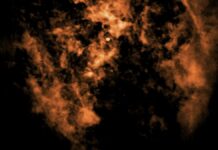
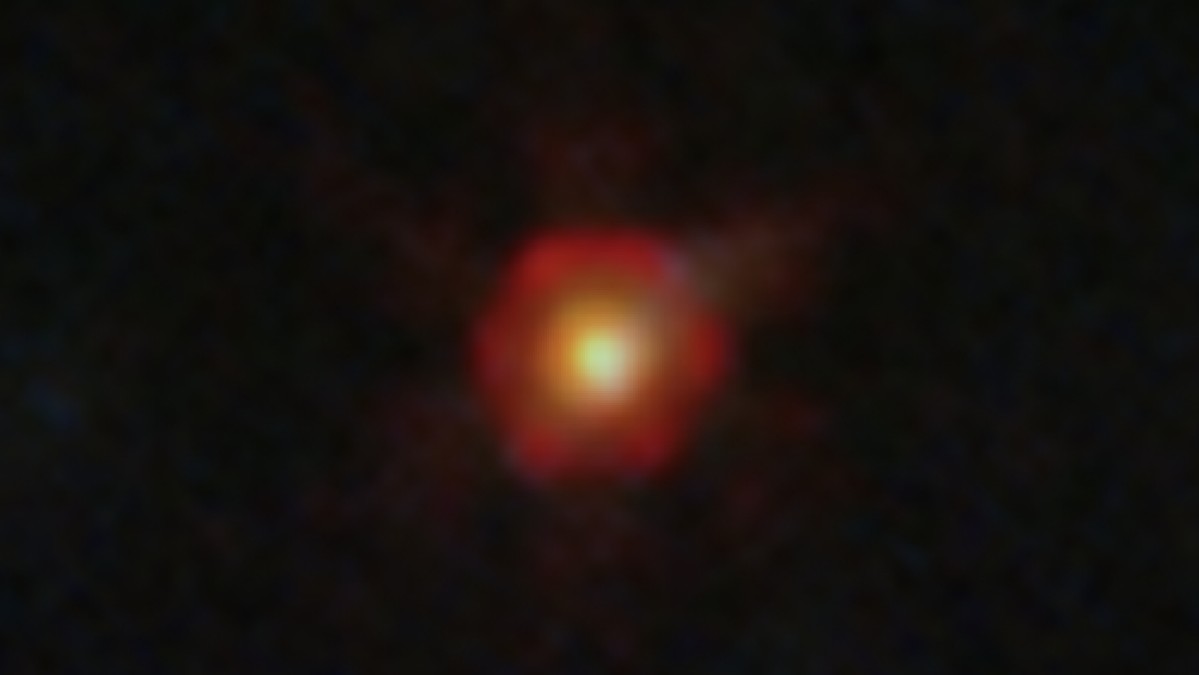
Enter the James Webb Space Telescope. It stared down GLIMPSE-177075. A distant, tiny, aggressively red smudge. Standard classification failed immediately. But Webb doesn’t just take pretty pictures. It tears light apart. The team found over 40 chemical signatures in that spectrum. Ingredients for a very specific kind of soup.
Here is what the data suggests: It is not a galaxy breaking the rules. It is a black hole. But not just any black hole. A voracious one, wrapped tightly in a thick cloud of gas.
The theory is out there already. The “black hole star.” Imagine a supermassive black hole feeding inside a dense ball of gas. Earlier clues pointed here—the weird hydrogen patterns, the compact size. But clues aren’t proof. They’re hints. Webb gave us the receipt.
How it hides in plain sight
Light from these objects doesn’t travel straight. It ricochets.
That is key. In normal galaxies, light escapes cleanly. In a GLIMPSE, the gas cocoon is incredibly dense. Matter falls into the black hole (a quasar), releasing energy. But that energy hits the wall. The gas absorbs it. Recycles it. Changes the color before the photons ever make it to Earth.
That is why it looks red. That is why it looks small.
The gas acts as a filter. Or a disguise.
Vasily Kokorev from the University of Texas called looking at the spectrum like finding puzzle pieces on the floor. Some looked like trash at first glance. Then two pieces clicked. Then another. Suddenly you see the picture.
And the picture resolves the biggest headache these objects caused: mass estimates.
Old methods measured how fast gas moved to guess the black hole’s weight. But if the environment distorts light? Those measurements were lying to us. The black holes might be smaller than we thought. They just grow fast. And they are hidden behind a heavy curtain.
So we don’t need to rewrite cosmology. We just needed to see through the curtain.
“Looking ahead, I’m eager to dive deep.”
The central engines of the early universe were loud, messy, and covered in dust. Nothing new about that, really. Black holes are always messy. The puzzle is solved, but the floor still has more pieces. What else are they hiding?