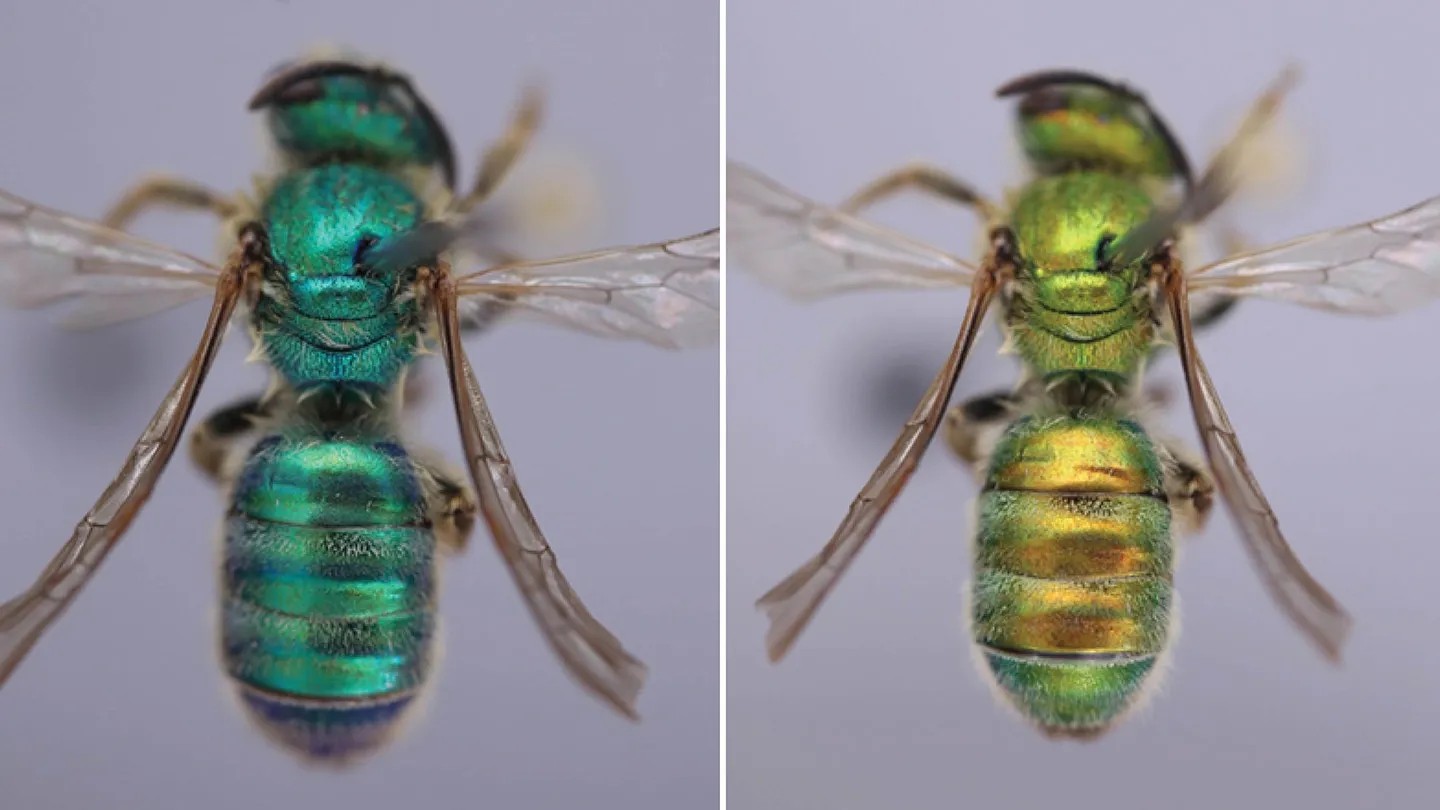
For many insects, color is not a permanent trait but a dynamic response to the environment. Recent research has revealed that certain species, specifically fine-striped sweat bees (Agapostemon subtilior ), undergo a visible color transformation when humidity levels shift.
This phenomenon, described in a study published in Biology Letters, suggests that the iridescent hues we observe in nature may be far more fluid than previously understood.
The Observation: From Blue-Green to Copper
The study began with a curious observation in museum collections. Researchers noticed that when bee specimens were placed in high-humidity chambers—a standard procedure used to make exoskeletons flexible for mounting—their colors shifted dramatically.
By comparing museum specimens with over 1,000 photographs of living bees captured via the citizen science app iNaturalist, researchers identified a clear pattern:
– Low Humidity (<10%): The bees exhibit a rich, deep blue-green hue.
– High Humidity (95%): The bees shift to a lighter, coppery green.
The Science of Iridescence
Unlike many animals that rely on pigments (chemical colors) to appear a certain way, these bees utilize structural coloration. This means their color is produced by microscopic structures in their exoskeleton that manipulate light.
The researchers propose that the change is driven by physical swelling:
1. Moisture Absorption: High humidity causes the microscopic layers within the bee’s exoskeleton to absorb water and swell.
2. Light Manipulation: As these layers expand, the physical distance between them increases.
3. Wavelength Shifting: This increased spacing changes how light waves are scattered. Specifically, it causes the bees to reflect longer, “redder” wavelengths, resulting in the shift from blue-green to copper.
“Color can be really dynamic and respond to the environment in ways we didn’t expect,” notes Madeleine Ostwald, a functional ecologist at Queen Mary University of London.
Why This Matters for Ecology
This discovery highlights a significant challenge for entomologists and citizen scientists alike. If an insect’s appearance changes based on the weather, a single species might appear as two different “colors” depending on when a photo is taken.
This raises important implications for several fields:
– Species Identification: Researchers must account for environmental variables to avoid misidentifying species based on color.
– Biological Context: It emphasizes the necessity of studying organisms in their natural habitats; once removed from their environment, their physical characteristics may no longer be representative of their living state.
– Broader Patterns: This phenomenon may not be limited to sweat bees. It could be a widespread trait among various insects that rely on microscopic structures rather than pigments for their visual identity.
Conclusion
The ability of sweat bees to change color in response to moisture reveals that insect appearance is an active, environmental dialogue rather than a static trait. This research serves as a reminder that even well-studied biological features can hold hidden complexities when viewed through the lens of environmental change.