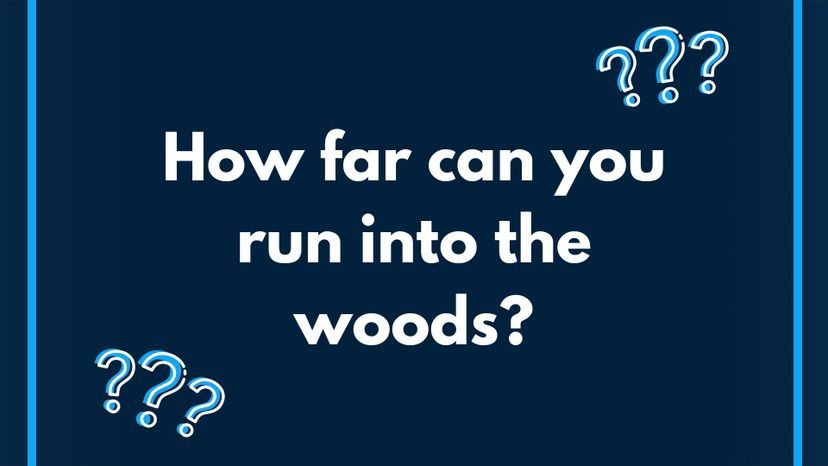
It starts simply enough. A riddle that feels like it’s coming from a nursery rhyme or a campfire story. You’re asked to identify a specific location based on a bizarre geometric constraint. The question is usually phrased as a challenge to your spatial reasoning. Or maybe just your common sense.
Halfway.
That’s the answer. But why does it work? It’s not just a word game. It’s a trick of perspective.
Think about the geometry of a forest. Trees are scattered. Paths wind. But a boundary is a concept. To be in the woods implies you have crossed a threshold. You are surrounded by greenery. You are within the limits of the tree line.
Now, consider the instruction: go in any further.
If you are already at the very center of the forest, moving forward doesn’t take you deeper. It takes you toward the other side. And eventually, you must exit. You run out of the woods.
The riddle relies on the definition of “halfway.”
In a linear path through a continuous space, halfway is the midpoint. If you start at edge A and move toward edge B, the halfway point is equidistant from both. But the riddle frames it differently. It suggests that at the halfway mark, any further progress in the direction you are facing results in leaving the area entirely.
This only makes sense if you interpret the “woods” not as a 2D plane, but as a specific, bounded zone where entry and exit are the only two directions.
Wait. That’s not quite right.
Let’s look at it again.
If you are in the woods, you are inside. To go “in” further suggests moving toward the center. But if you are already at the center? No, that’s not it. The riddle says “if you go in any further.”
Here is the key. The phrase “go in” is ambiguous. Does it mean “enter the woods” or “move deeper inside”?
Most people assume “go in” means “move deeper into the interior.” But the punchline hinges on the word “halfway” being a literal location on the threshold.
Actually, no. That’s overthinking it.
The answer is “halfway” because it is the only position where a forward motion (continuing in the same direction you entered) leads to exit.
Consider a straight line path through a forest.
1. You enter.
2. You walk.
3. You reach the halfway point.
4. You continue walking.
5. You exit.
At the halfway point, you have covered 50% of the distance. If you go “in any further” (meaning, continue your forward momentum), you are moving toward the exit. You are no longer going “in” to a deeper part of the woods in terms of distance from the entry point. You are going out.
But the riddle phrasing is tricky. “If you go in any further, you’d be running OUT of the woods.”
This implies that at the halfway point, the direction of “in” reverses. Or rather, that “in” is a relative term.
There is a simpler explanation. It’s a play