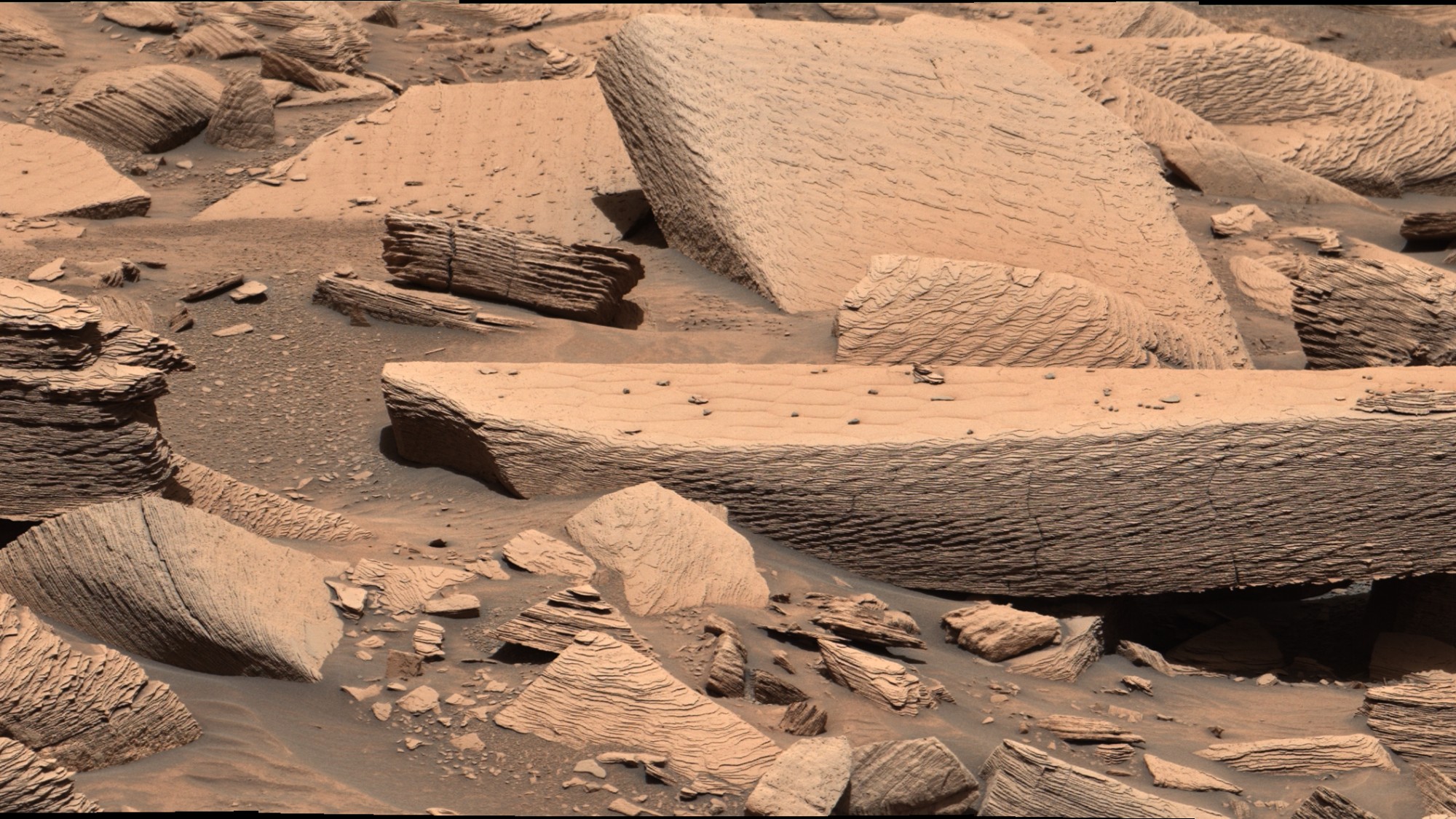
The dust settles. Or rather, it used to.
On the surface of Mars today, you’d expect barren red wasteland. And you’d mostly be right. But billions of years ago, the Red Planet was a different beast entirely. It had an atmosphere. It had weather. And sometimes, it had sandstorms so violent they changed the geology permanently.
That’s the takeaway from new analysis of images taken by NASA’s Curiosity rover. Specifically, a location the team jokingly (or perhaps grimly) dubbed “Jawbone Canyon.”
What looks like simple rock outcrops in Curiosity’s snapshots might actually be the fossilized remains of a catastrophic wind event. Experts believe ancient sandstorms blew across this landscape with enough force to push grains into rippling waves. Those waves didn’t just shift with the breeze; they lithified. They hardened into solid rock, preserving the storm’s shape for millions of years.
Look closely at the image from Jawbone Canyon. Really look.
Do you see those subtle ripples on the rock surfaces? That’s the evidence. It’s not just erosion. It’s a snapshot of wind speed and direction, locked in stone. The winds were so extreme they sculpted the sand before it settled and fused.
This wasn’t discovered last week. Curiosity snapped these images in 2024. But the interpretation is fresh. A new study, published this year in the journal Geology, dives deep into the mechanics of how these ancient dunes formed. The researchers aren’t just looking at pretty pictures. They’re reconstructing the climate of a lost Mars.
Why does this matter? Why do we keep looking at this dry rock?
Because this discovery is part of a half-century journey.
Mark the date: July 20, 1965, Mariner 4 flies by. But July 20, 1976, is the real milestone. That’s when NASA’s Viking 1 lander touched down. Before Viking 1, we had the Soviet Mars 3, which landed in 1971 but lost contact after mere seconds. Viking 1 survived. It sent back the first images of the Martian surface. It studied the soil. It sparked the burning question: Did this world ever support life?
Viking 1 proved we could land. We could stay. We could listen to the planet.
Without that 1976 success, Curiosity wouldn’t be here. Without Curiosity, we wouldn’t have Perseverance. These rovers aren’t just rolling rocks. They are the direct descendants of Viking’s legacy.
The study of the sandstorms in Jawbone Canyon adds another layer to that legacy. It suggests that the wind on ancient Mars wasn’t just a nuisance. It was a geological architect.
We often think of Mars as dead. Static. The dust storm of 2018 was a reminder that the atmosphere can still be volatile, even now. But these ripples in the rock? They belong to a wetter, windier world. One that had lakes. Rivers. Maybe even life.
Curiosity is still moving. Still looking. The data from those 2024 shots is already helping us rewrite the climate history of the Red Planet.
It’s humbling, isn’t it? That the storms we can barely imagine shaped the ground we stand on today.
The rover continues its climb up Mount Sharp. The sand keeps moving, even if we can’t always see it. And somewhere in the dust, those ancient ripples wait for us to read them correctly.