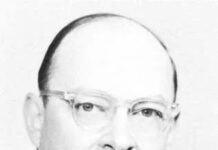
Rudolf Schoenheimer was the man who looked at a piece of bread and saw a moving target.
Born in Berlin in 1898, he was a biochemist who changed our understanding of the human body. It’s not an autopsy. It’s not based on guesswork. However, it is done through labeling.
He developed a technique to “label” molecules with radioactive isotopes. This sounds like science fiction. It was like magic at the time. This allows researchers to track the movement of organic matter through animals and plants. Until then, metabolism was a black box. We know that food comes in, and we know that waste goes out. We don’t know what happened in the messy middle.
Schoenheimer opened the box.
The Heavy Hydrogen Connection
Schoenheimer studied medicine at the University of Berlin and graduated in 1923. Until 1933, he taught biochemistry in Leipzig and Freiburg. The political situation in Germany is changing. He traveled to the United States.
He enrolled at Columbia University. There he collaborated with Harold C. Urey. Yuri discovered deuterium, also known as deuterium. It is an isotope of hydrogen. It has a neutron in its nucleus. Therefore, it is heavier than ordinary hydrogen. Chemically, however, it behaves almost exactly the same.
This is the key.
Schoenheimer and colleague David Rittenberg use these isotopes to label food ingredients. They fed labeled nutrients to animals. Then they examine the tissue. Isotopes appear. They stayed put. Or they moved. They revealed the path.
“These isotopes are identified in the tissues of fed animals and help us understand what happens to the food in the metabolism.”
Why this changes everything
Most people think of metabolism as a static process. You eat. You burn. You store.
Schoenheimer shows that it is dynamic. This is a constantly changing state. Molecules in the body are not fixed. They are replaced. Constantly.
He applied this to cholesterol. He studied the relationship with atherosclerosis. He showed that there is more to cholesterol than that. It is being made and broken down. It’s part of the cycle.
This insight helps explain why diet is important. Why the body reacts the way it does? Why some things stick around and others don’t?
Tragic ending
Schoenheimer was at the height of his career. He revolutionized metabolic research. He gave science new tools. A way to see the invisible.
He died in New York on September 11, 1941. he committed suicide. The reasons are complex. The pressure of the times. The stress of the work. The personal toll. It remains a dark footnote in a bright science story.
His method, however, lived on. Isotope tracking is the standard in today’s research. We use it to trace drugs. To study cancer. To understand nutrition. We still use the tools he helped build. We still follow the isotopes.
We still don’t see everything. But we see more than ever before.
The body is not a machine. It is a river. Schoenheimer taught us how to watch the water flow.