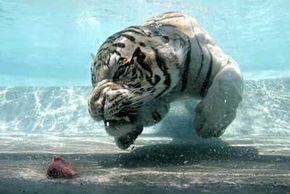
Odin isn’t the All-Father. He doesn’t have the wisdom of the well, nor the single eye of the Norse myth. He is a 445-pound Siberian tiger living at Six Flags Discovery Kingdom in Vallejo, California. And he has a habit that defies almost every stereotype about big cats.
Most cats hate water. Flick a few drops near a house cat and you’ll watch them bolt. It’s in their wiring. But Odin doesn’t bolt. He dives.
He enters the pool with eyes wide and ears pinned back, sinking to the bottom with the grace of a seal. He doesn’t care about mythology. He cares about the meat.
The Science of the Splash-Proof Predator
Why do tigers swim when lions, leopards, and jaguars generally don’t?
It comes down to geography. Tigers evolved in the wetlands of Asia. They live in areas with monsoons, dense jungles, and rivers that can swell during rainy seasons. Swimming isn’t a party trick for them. It’s survival.
“Swimming serves a few key purposes.”
For a tiger, water is a tool. It cools them down. It helps them hunt by masking their scent from prey. It even helps them cross wide gaps in their territory.
Odin’s white Bengal coat is rare. White tigers aren’t a separate subspecies. They’re Bengal tigers with a genetic mutation that affects their pigment. But the mutation doesn’t change their instincts. They still know how to handle the wet stuff.
How to Train a Tiger to Dive
You don’t coerce a 400-pound apex predator into a pool. You negotiate.
Odin’s trainer doesn’t shout. He tosses meat.
The reward is simple. A piece of food hits the surface. Odin holds his breath and dives to get it. He repeats this. Again and again. The behavior wasn’t taught from scratch. Odin picked it up by watching another tiger at the park. He saw the behavior. He adopted it.
This isn’t unique to Odin. There are other felines who break the mold. Hawkeye, a domestic cat, wears custom scuba gear. He dives into his owner’s pool on his own. But a house cat is small. A tiger is a force of nature. Getting a tiger to dive requires trust, routine, and high-value rewards.
The Myth vs. The Reality
The Norse god Odin traded an eye for wisdom. He sits on a throne. He watches the world burn.
The tiger Odin jumps into a pool. He grabs a chicken. He swims back to the edge.
Both are figures of power. But only one is wet.
The image of the white tiger diving is striking. It challenges our understanding of cats. We think of them as dry, aloof, and independent. Odin proves that they can be playful, adaptable, and deeply connected to their environment.
Is it strange? Yes.
Is it rare? For a white tiger at a theme park, no. For a wild tiger, it’s daily life.
The next time you see a tiger in a zoo enclosure, look for the water. If it’s there, the tiger might just be checking the temperature. Or waiting for the trainer to throw dinner.
There are only about 4,000 tigers left in the wild. That number is critically low. Six subspecies remain: Amur, Siberian, Bengal, Indochinese, South China, and Sumatran. They live across the Eastern Hemisphere. Most are packed into Southeast Asia’s tropical evergreen forests.
The climate there is intense. Summer in south India regularly hits 100 degrees Fahrenheit. That is 37.7 degrees Celsius. It is hot. Not habanero hot, but close. Thai chili hot.
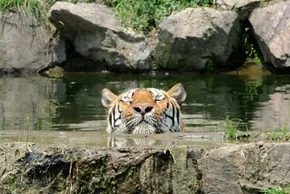
When humans get this hot, they jump in a pool. Tigers do the same. The main reason tigers swim is to cool off. They hunt at night. During the day, they lounge in the water like vacationers at a Miami resort. Tigers are the largest big cats. More surface area means more heat buildup. Swimming helps them regulate that temperature.
House cats hate getting wet. Their fur holds too much water. It makes them cold and uncomfortable. Tigers don’t have that problem. They swim for pleasure.
Swimming mechanics and eye protection
Most tigers don’t dive. They wade. They submerge their bodies but keep their heads up. Water in the eyes is annoying. Tigers dislike it. They often wade until the water is up to their necks.
Some, like the zoo tiger Odin, will dive. Their eyes stay open. This is rare. It is an oddity.
To keep water out, some tigers enter the pool backwards. They protect their eyes like humans protect their hair. They are careful.
Physical traits for swimming
Tigers are strong swimmers. They have powerful bodies. Their paws are partially webbed. This gives them extra push in the water.
They can travel far. Recordings show them crossing rivers 18 miles wide. That is 29 kilometers. They have swum 9 miles, or 15 kilometers, in open water.
Swimming is not just for fun. It is a hunting tool. Tigers chase prey into the water. They trap it there. The water becomes a weapon.
Other big cats and water
Tigers are not the only big cats that swim. Jaguars swim too. Lions swim. It happens in warm climates.
African lions in Botswana’s Okavango Delta swim to dry land. Seasonal floods wipe out their range. They have to move. Panthers in the Florida Everglades do the same. They migrate when the water rises.
Fido still beats cats at swimming. Dogs are natural swimmers. But tigers, jaguars, and lions show that big cats are not afraid of water. The phrase “doggy paddle” might need a rethink.
The water keeps them cool. It helps them hunt. It helps them survive. The heat is getting worse. The wild is getting smaller. Tigers adapt. They swim. We watch. And we wonder if we should be more like them. Or less.