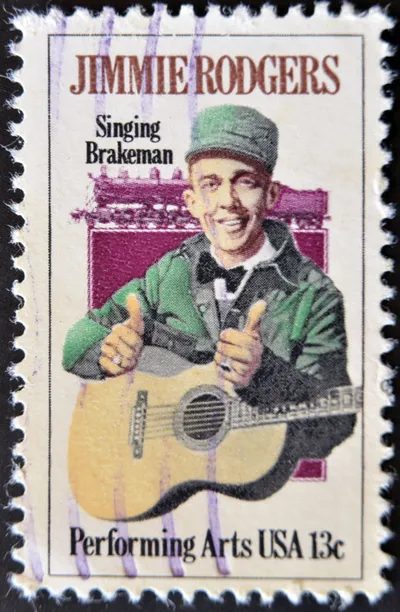
Jimmie Rodgers didn’t just sing country music. He built the stage it was performed on.
Born in 1897 near Meridian, Mississippi, to a railroad foreman whose wife died early on, Rodgers’ childhood was a blur of transient southern towns. He didn’t stay in school. At 13, he ran off with a medicine show. By 14, he was done with education entirely. Instead, he joined his father’s railroad gangs. This wasn’t glamorous work. He started as a water carrier, hauling water to steam engines. He became a baggage master. A flagman. A brakeman.
But the rails gave him something else. Exposure.
While working the line between New Orleans and Meridian, Rodgers listened. He absorbed the work songs of African American laborers. He absorbed the early blues. He absorbed the hobo tales and cowboy ballads. He learned guitar and banjo, mixing these disparate threads into a sound that felt entirely new. It was personal. It was gritty. It was the root of what we now call country and western.
Then the tuberculosis hit.
Around 1924 or 1925, his lungs gave out. Railroad work was no longer an option. He needed a dry climate. He needed money. So, he tried performing. Street corners. Tent shows. It went poorly. Not well. He moved to Asheville, North Carolina, where he found a lifeline in local radio. He backed a string band formerly known as the Tenneva Ramblers. They renamed themselves the Jimmie Rodgers Entertainers. They played resorts. They traveled to Bristol, Tennessee, hoping to catch the eye of Victor Talking Machine Company field recorders.
The band fell apart over a dispute. The Ramblers went solo.
But Ralph Peer at Victor saw something in Rodgers. They recorded him as a solo artist. Just him and his guitar.
The first record? “Sleep, Baby, Sleep.” It sold. It proved he had a voice that could carry. This single track opened doors. He recorded again. This time in New Jersey. Then again. And again. Between 1928 and 1933, he cut more than 110 records.
The Great Depression was starting. The economy was collapsing. People needed escape. They needed hope. They found it in Rodgers’ voice.
He toured the South. He hit the vaudeville circuit. He eventually settled in Texas, leaning into the cowboy aesthetic to soothe his lungs and market his image. He prefigured the “Singing Cowboy” archetype that Gene Autry would later monetize on a massive scale. But Rodgers was doing the heavy lifting in the studio.
His vocal style broke the mold. Before Rodgers, hillbilly music was largely instrumental or sung in a lugubrious, uniform drone. Rodgers injected personality. Humor. Heightened emotion. He sounded different. He felt different.
Biographer Nolan Porterfield noted that Rodgers transformed the genre by refusing to sound like everyone else.
And then there was the yodel.
The famous blue yodel. It became his signature. It appeared on “Blue Yodel No. 1.” It anchored a dozen other recorded versions. Where did it come from? Scholars argue. Some say Tirolese minstrels. Others blame work-gang calls. Maybe he was trying to imitate a train whistle. The mystery didn’t matter. The sound did. It cut through the static. It connected.
His songwriting was a collaboration, often with his sister-in-law Elsie McWilliams. The hits spanned every emotional extreme. “Miss the Mississipi and You.” “Daddy and Home.” “My Carolina Sunshine Girl.” “Waiting for a Train.” “Brakeman’s Blues.” Even covers like “Frankie and Johnny” and “Mississippi River Blues” were filtered through his unique lens. “My Time Ain’t Long” captured the fleeting nature of existence with a starkness that still resonates.
His influence is visible in almost every country giant that followed. Gene Autry. Ernest Tubb. Merle Haggard. Hank Snow. Lefty Frizzell. They all owed a debt to the man who sang while lying on a cot in the studio, too sick to stand, too driven to stop.
Rodgers recorded until his health failed completely. He died in New York City in 1933, at just 35 years old.
He was the first inductee into the Country Music Hall of Fame. Not because he was the loudest. Not because he was the most technically proficient. But because he figured out how to make a genre feel like a person. He took the noise of the railroad and turned it into music.
The trains keep running. The songs keep playing. But the blueprint he drew is still there, worn into the grooves of every record that follows.