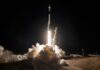
They were named for a mythological beast, but they served a very practical, deadly purpose. Launched in 1965, three US scientific satellites known as Pegasus were among the largest spacecraft America had ever built. Their center section stretched 71 feet into the void. But the real story was in their wings.
These winglike structures spanned a massive 96 feet. Why such a huge target? To catch micrometeoroids.
Space isn’t empty. It is filled with high-speed particles of space dust. To the naked eye, they are invisible. To a spacecraft traveling at orbital velocity, they are like bullets. The Pegasus satellites were designed to record the depth and frequency with which their wings were pierced by these tiny projectiles.
The Apollo Connection
This data wasn’t just for curiosity. It was for survival. Engineers used the Pegasus findings to design the outer shell of the crewed Apollo spacecraft. They needed to prevent penetration from these high-speed particles. One hole in a pressurized cabin in space is a fatal error.
The implications extended beyond the hull. The data helped engineers develop space suits that would shield astronauts from micrometeoroids when working outside their spacecraft. EVA (extravehicular activity) required protection against invisible hazards. Pegasus provided the statistics needed to build that armor.
A Large Scale Experiment
At the time of their launch, Pegasus satellites were giants. Their sheer size was necessary to capture enough data points. A small target would yield too few impacts to be statistically significant. The 96-foot span ensured a high probability of collision with space debris.
The information gathered was critical for the success of the Apollo missions. It allowed NASA to engineer resilience into their vehicles and their astronauts. Without this knowledge, the risk of micrometeoroid strikes would have remained a guessing game.
The Pegasus satellites provided the statistical backbone for protecting human life in space.
The winged horse of Greek mythology carried a payload of hard data. That data kept the Apollo crews safe. It turned a mythological symbol into a practical shield against the vacuum.