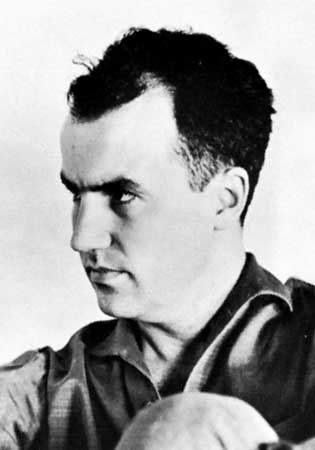
Luigi Nono did not write for the faint of heart. If you thought modern classical music was just quiet piano pieces in a dimly lit hall, you clearly hadn’t attended a performance of his work. Born in Venice on January 29, 1924, Nono became one of Italy’s most provocative musical voices. He died there on May 8, 1990, leaving behind a legacy of electronic experimentation, serial techniques, and music that refused to stay neutral.
His path to fame wasn’t linear. He started at the Venice Conservatory in 1941. Then he switched gears. He studied law at the University of Padua, earning a doctorate. But while he was reading legal texts, he was also studying with Bruno Maderna and Hermann Scherchen. Two heavy hitters in the avant-garde scene. This dual education gave him a unique perspective. He understood structure, but he wanted to break it.
Public attention arrived in 1950. His piece Variazioni Canoniche was an orchestral variation on a twelve-tone theme by Arnold Schoenberg. It was sharp, intellectual, and clearly marked him as a serious talent. That same era saw him marry Schoenberg’s daughter, Nuria, in 1955. The connection to the first great serialist wasn’t just personal; it was philosophical. Nono taught at the Kranichsteiner Music Institute in Darmstadt, Germany, and lectured across Europe and the US. He was spreading the gospel of new music, and people were listening.
How Luigi Nono Used Fragmentation in His Compositions
What actually makes a Luigi Nono composition stand out in a crowded field of 20th-century classical music? It’s the clarity. Not simplicity, but clarity. He explored polyphony, monophony, and rhythm in ways that felt direct, even when the notes were complex.
Take Polifonica-monodia-ritmica from 1951. It’s scored for seven instruments. It’s straightforward. It cuts through the fog.
Then there’s The Suspended Song (1955–56). This is where things get heavy. It’s a serial setting for voices, chorus, and orchestra. The text? Letters written by victims of Nazism. Nono passed the melody among instruments and voices. Each performer rarely played more than a single note. It’s fragmentation as an emotional device. The isolation in the sound mirrors the isolation in the letters. He used this technique in other works, too, often mixing voices with percussion.
By 1967, he was looking East. Per Bastiana Tai-yang Cheng was based on a Chinese folk song. It celebrated the birth of his daughter. It’s somewhat aleatoric—chance elements play a role. The score calls for three instrumental groups playing in quarter tones and magnetic tape. It was personal, experimental, and culturally specific all at once.
Why Luigi Nono’s Opera Intolleranza 1960 Caused a Riot
You can’t talk about Nono without talking about politics. He was an avowed Communist. He didn’t hide it. He didn’t shy away from controversy. And that got him into trouble.
His opera Intolleranza 1960 premiered in Venice in 1961. Nono called it a “mural.” It attacked fascism, the atom bomb, and segregation. The ending was symbolic and brutal: the world is flooded and destroyed.
Did it go over well? No. Neofascists stormed the performance. A riot broke out between them and communist supporters. The audience didn’t just hear the music; they lived it. It was dangerous.
He later revised it as Intolleranza 1970. The core message remained, but the context shifted. The world had changed, and so had the urgency of the work.
The Paris Commune and La Scala Commission
In the early 1970s, La Scala in Milan commissioned a new opera. Nono delivered Al Gran Sole Carico d’Amore (1972–75). The title comes from a poem by Arthur Rimbaud. The subject? The Paris Commune of 1871.
It wasn’t a traditional opera. No conventional plot. No clear characters. It was about class struggle. The influence of Schoenberg’s pre-World War I Expressionism is obvious here. Dark, jagged, emotionally raw.
Despite the commission, it didn’t premiere at La Scala. It went to Teatro Lirico. La Scala produced a revised version in 1978, but the initial staging was a statement of intent. Nono was challenging the establishment from within the establishment.
Political Works and Later Legacy
Nuno was inspired by Spanish poet Federico García Lorca. He wrote Der Rote Mantel (1954) based on one of Lorca’s poems. Epitaffio per Federico García Lorca (1952) was hailed as a major work. It’s a set of three pieces in memory of the poet. Lorca’s murder by fascist forces clearly left a mark.
Other works doubled down on political themes. Sul ponte di Hiroshima (1962) dealt with nuclear warfare. Ein Gespenst geht um in der Welt (1971) set The Communist Manifesto to music for voice and orchestra. Canto per il Vietnam (1973) addressed the war in Southeast Asia.
He was a longtime member of the Italian Communist Party. He was elected to its Central Committee in 1975. He stayed there until he died. The party wasn’t just a background detail; it was the lens through which he viewed art.
His later works show a shift toward intimacy and tribute. A Pierre: Dell’azzurro silenzio, inquietum (1985) is for bass flute, contr