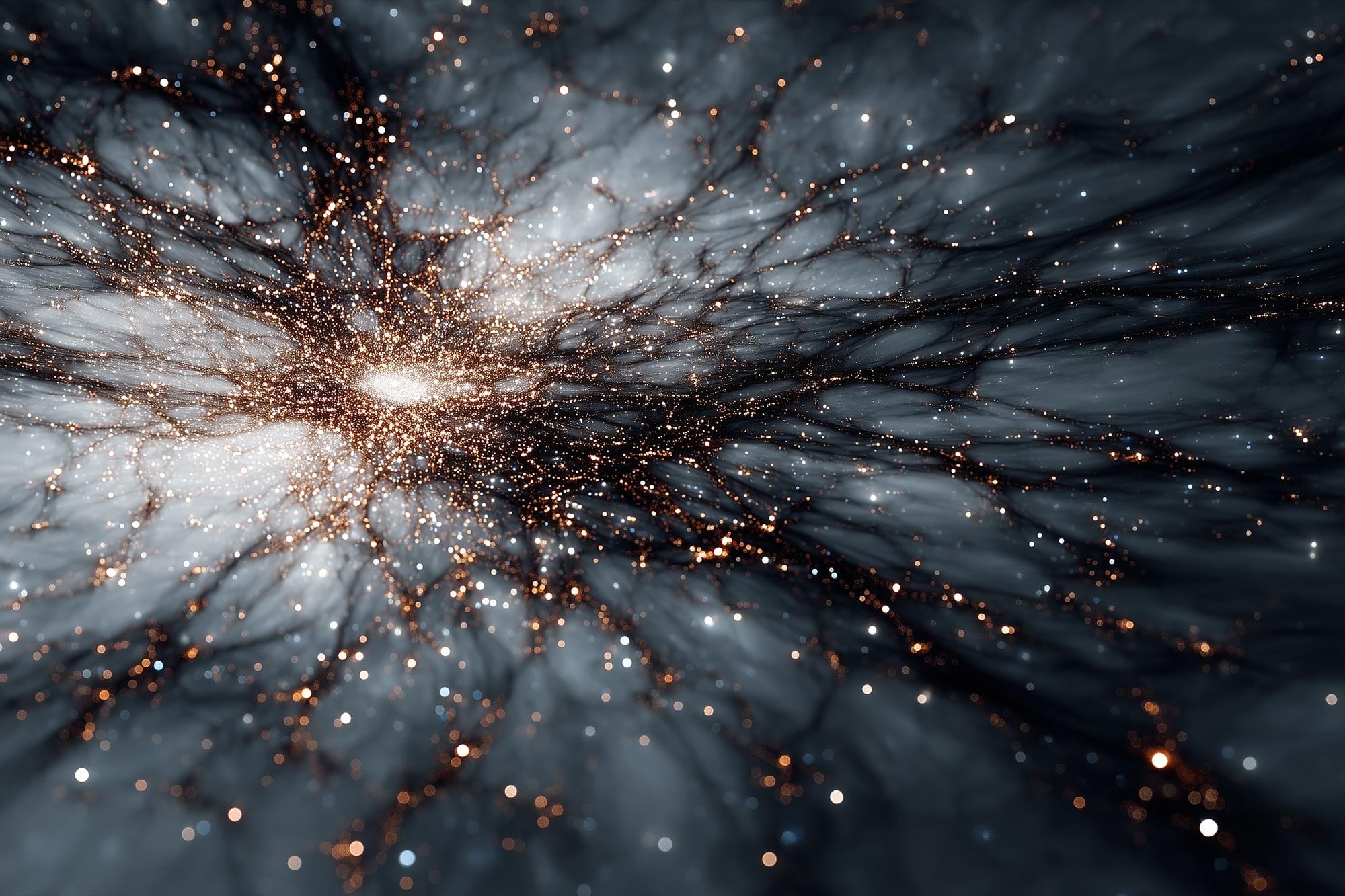
Everything you can see? Just a fraction. Stars. Planets. Dust. It adds up to maybe 15% of the matter in the universe. The rest? Dark. Invisible. Heavy.
For decades we assumed dark matter kept to itself. Neutrinos kept to theirs. They were separate ingredients in the cosmic soup. Cold. Distant.
A team at the University of Sheffield thinks we’ve been wrong. Or at least incomplete. They published in Nature Astronomy. The finding suggests these two hidden components might actually interact. That’s big news. It implies physics we haven’t mapped yet.
The standard story is cracking
Let’s look at the numbers. Dark matter makes up roughly 85% of matter. We’ve never touched it. Never saw it. We only know it’s there because it pulls on galaxies like a ghost hand. Then you have neutrinos. Ghostly particles. Tiny mass. They fly through your body every second. Billions of them. You don’t feel them.
The current rulebook is the Lambda-CDM model. Based on Einstein. In this version of reality, dark matter and neutrinos ignore each other completely.
Sheffield researchers looked at that rule and saw a crack.
They didn’t just guess. They compared data from the early universe against data from now. Why? Because if these particles bounce off each other, it changes how stuff clumps together. It changes history.
The clumping problem
Here’s the snag. When we look at the afterglow of the BigBang — using data from the Atacama Cosmology telescope and ESA’s Planck — we get a prediction. Gravity should have pulled matter together strongly by now. Strongly.
But we look out at today’s galaxies — using the Dark Energy Camera in Chile and maps from Sloan — and see something different.
The universe is slightly less clumpy than it should be.
“The better we understand dark matter… the more insight we gain,” Dr. Eleonora Di Vallentino says. She notes that measurements of the early universe predict strong growth. “Measurements of the modern universe indicate that matter is slightly less clamped than expected.”
Is the standard model broken? No. It might just be missing a line item. A small tension. But a tension nonetheless.
What does that even mean
If dark matter and neutrinos interact, they’d sort of drag on each other. Like mud. This drag would slow down the clumping process. It fits the data better. It solves the mismatch without throwing out relativity entirely.
Dr. William Giaré calls it a “fundamental breakthrough” if confirmed. He’s no longer at Sheffield, working at the University of Hawaii now, but the hype remains. He says this gives particle physicists a concrete direction. Instead of searching blindly, they have a clue about what properties to hunt for in the lab.
We aren’t done yet
We don’t know this is real. Not yet. We need sharper eyes.
Future surveys. Cosmic Microwave Background experiments. Weak lensing data — using the way gravity bends light to map invisible mass — will test this. If the bending matches the interaction model? We change the textbook. If not? We keep looking.
It’s an open door. A slightly ajar one. The universe might be whispering that we missed the handshake between the dark and the ghost. Or we’re just chasing noise.
Either way, the silence is getting louder.