Wake up. Or try to.
Before July 11’s sunrise, the east-northeast holds a quiet lineup worth setting an alarm for.
The moon
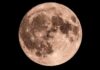
The moon is a waning crescent tonight, thin as a sliver of ice, sitting at just 14% illumination. It climbs up around 2 a.m. local daylight time.
It doesn’t look like much from the side but look closer at the dark side of that curve. It glows. That’s earthshine. The old saying calls it “the old moon in the new month’s arms” but Da Vinci nailed the science first. Light hits Earth, bounces to the Moon, bounces back to us. Ghostly gray. Beautiful.
Mars and Aldebaran
Hang tight about five degrees below that crescent and you’ll spot Mars.
Orange-yellow. A planet masquerading as a star. Hold your fist up at arm’s length. Mars is sitting there roughly half a fist-width down from the Moon. It rises a bit later, around 2:40 a.m., sitting about one-and-a-half fists above the horizon by dawn light.
It’s dimming out right now inside the bull. Taurus. Mars is actually getting closer to Earth—15.4 light-minutes away by September—but the brightness increase is painfully slow. From magnitude +1.3 to 1.2. We won’t see it really shine until February. Not then though. Right now it’s subtle.
Below Mars. A little lower, slightly right.
Aldebaran.
This isn’t a planet. It’s the bull’s angry right eye. Orange-red. Twice as bright as the planet next door.
It’s a red giant. Older than the Sun. Bigger. 45 times wider, in fact. It burns hotter—about 6,760°F—on its surface despite the red hue, preparing to crush hydrogen into heavier elements. It sits 67 light-years out.
Aldebaran isn’t part of the cluster behind it, either. Just passing by. An “innocent bystander” making the Bull look like it has a face. Henry Neely used to say that seeing inside that V-shape without binoculars was basically missing out on the jewelry box. He was right.
The Pleiades
And then there’s the cluster.
The Pleiades hang six degrees upper right from the moon.
“like a swarm of fireflies tangled, in a silver, braid.”
That’s how Tennyson saw them. Binoculars will split that single fuzzy star into a score of points of light. A thousand, if you have a good telescope and a steady hand.
Why bother getting out of bed for this?
“An ancient, sparkle waiting quietly above the waking, world.”
Because it’s right there. Before the light eats it.
Want to look? Grab some binoculars if you haven’t yet. Or a camera.
[Best binoculars deals]
[Best telescopes deals]
[Cameras for astrophotography]