Imagine a future where your quantum computer isn’t a single, fragile chip. It’s a network of modules. Physically separated. Yet behaving as one coherent machine.
For two decades, physicists knew this was theoretically possible. They just couldn’t prove it without active, messy control.
That changed recently.
Researchers at the Institute of Science and Technology Austria (ISTA) have confirmed a prediction from 2006. They demonstrated autonomous distributed quantum entanglement. No repeated measurements. No active post-selection. Just a “quantum bath” that keeps qubits linked.
It’s a big deal for quantum networking.
How a Quantum Bath Replaces Active Control
Traditional methods for entangling distant qubits are exhausting.
You usually have two choices. Send a controlled photon from A to B. Or have both emit photons, then match them. The latter approach won the 2022 Nobel Prize. It’s elegant. It’s also unreliable. It depends on chance. It fails most of the time. You have to sift through the noise to find the signal.
Alejandro Andrés-Juanes and Professor Johannes Fink at ISTA took a different path.
They built a quantum bath.
Think of it as an environment. A shared source of correlated light particles directs energy toward two separated qubits. The bath does the work. It forces the qubits into sync automatically.
“By stabilizing the entangled states remotely our approach is fully autonomous and requires no active or measurement.”
This solves a specific mismatch.
Nature loves continuous variable entanglement. It flows smoothly. Like the position of a pendulum. Easy to make.
Most quantum computers need discrete variable entanglement. Binary. All-or-nothing. Hard to generate directly.
The ISTA team used the bath to convert the continuous into the discrete. They bridged the gap between what is easy to produce and what is practically useful.
Why Entanglement Outlasts the Qubits
Here is the core advantage.
In standard systems, entanglement is fleeting. It dies when the qubits decohere. You have to act fast. If you miss the window. The connection breaks.
The quantum bath changes the rules.
The environment itself becomes the source of stability. A continuous stream of microwave photons maintains the shared state.
It creates a new ground state.
The entangled state survives longer than the individual qubits’ natural lifetime. It stays available. Always ready. This is conceptually significant. You don’t rush. You access the resource when you need it.
Andrés-Juanes notes that this method could scale. It’s not limited to two qubits. You could synchronize multiple distant processors.
Where This Fits in the Quantum Landscape
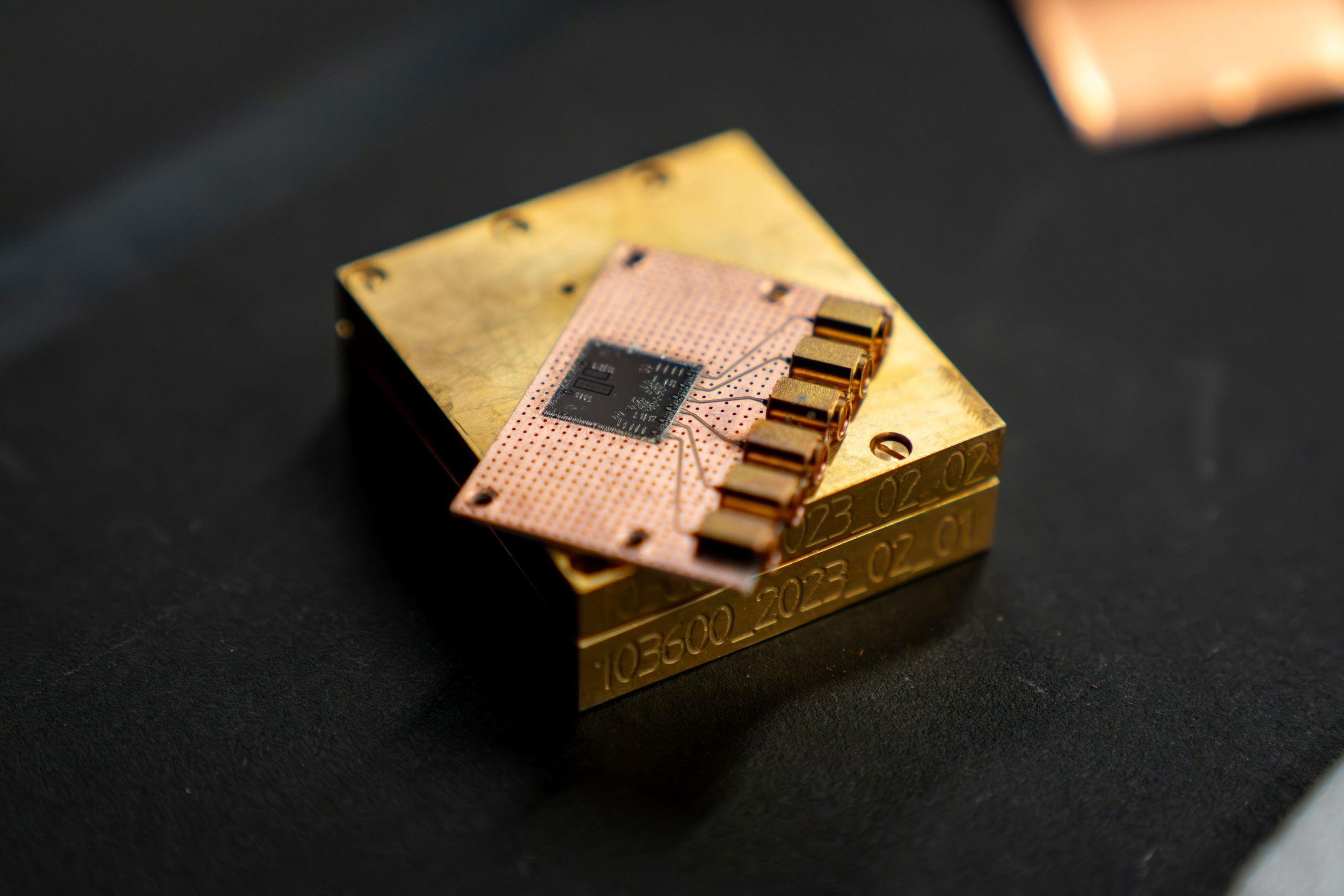
The experiment used superconducting qubits. These are the workhorses of companies like IBM and Google.
The bath communicated via microwave photons. Low energy. Precise control.
But there’s a broader goal.
Fink’s group is also looking at optical photons. These travel through fiber optic cables. They carry quantum information over distances. Microwave photons handle the local processing. Optical photons handle the long-haul connection.
The ISTA prototype is a step toward hybrid systems. Local stability meets global connectivity.
Which Limitations Remain?
Don’t get too excited.
The method works. It’s a proof of concept.
But it’s not efficient yet.
Currently, the system transfers only about 10% of the bath’s available entanglement. Active control methods are faster. They’re more precise in the short term.
Why did it take 20 years?
The original theory assumed ideal conditions. Real labs are messy. Fink explains that previous scientists couldn’t design a functional quantum bath because of experimental noise. They missed factors that prevented the single-source correlation from working.
The ISTA team verified the results using quantum tomography. They reconstructed the state from measurements lasting just 20–80 nanoseconds One billionth of a second is a long time in quantum physics. They caught the state before it collapsed.
“Qubits can be in a super position of states but all these states collapse when we measure the leaving us with a 0 or a 1 state.”
So.
Is it ready for your laptop? No.
Is it a foundation for fault-tolerant quantum networks? Possibly.
The bath keeps the connection alive. It waits. It doesn’t force. And for distributed quantum computing, that patience might be the most important feature of all.