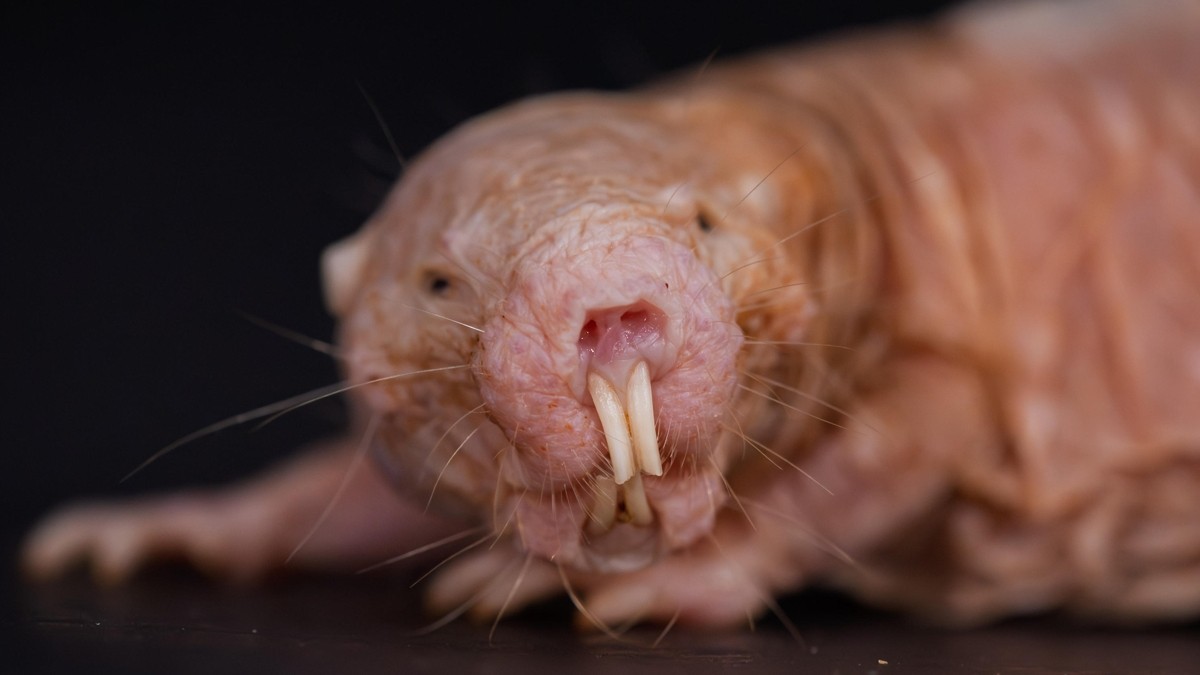
They are ugly. Or cute. You decide. Naked mole rats have wrinkly, hairless skin, protruding teeth, and the kind of wrinkly faces that make you want to either hug them or run away. They chirp with accents. They can survive without oxygen for eighteen minutes. And they have a pain tolerance that defies biology, likely due to specialized molecules in their bodies that render them immune to certain types of agony.
But longevity is what really got people’s attention. These rodents live nearly 40 years. That is ten times longer than mice. And unlike us, they don’t seem to get cancer as they age. Their cognitive faculties hold steady. They defy Gompertz’s Law, which predicts exponential decline in mortality as animals get older.
For years, researchers obsessed over their cellular mechanisms. They looked for the secrets of aging. They wanted to know why their DNA stays stable while ours fractures.
But a new study published in Nature reveals that the naked mole rat’s most powerful tool isn’t biological magic. It’s smell.
The Chemical Hierarchy
Naked mole rats live like ants. They dwell underground in complex tunnel networks. And like social insects, they are strictly hierarchical. One female, the queen, breeds. Dozens of others do not.
Those workers dig. They defend the tunnels. They raise the pups. It is a brutal, efficient society.
We’ve known for decades that if you remove the queen, chaos ensues. Subordinate females battle. Fights to the death happen. The hierarchy shatters until a new dominant female emerges.
The mystery was simple: How does the queen keep the rest of the colony sterile for her entire 30-year reign?
Researchers led by Mohammed Khallaf at the Max Delbrück Center for Molecular Medicine in Berlin identified the culprit. It’s a compound called isopropyl myristate (IPM).
Humans can’t smell it. IPM is common in cosmetics. It’s odorless to us. But in the dark, humid tunnels of the naked mole rat colony, it acts as a pheromonal leash.
“It works even when the queen is absent,” Khallaf says. “In the world of naked mole rats, it is reality.”
Tracing the Scent
The team started by confirming the animals rely heavily on scent. They analyzed samples from over 350 mole rats. They found hundreds of volatile organic compounds.
One stood out. Isopropyl myristate.
It was abundant in queens. Almost undetectable in everyone else. Levels spiked when the queen was ovulating.
Unlike many scents that evaporate quickly, IPM lingers. It hangs in the air of the tunnels. The queen patrols more than others, effectively spreading the scent throughout her kingdom. It is a chemical map of power.
Suppressed Hormones, Silent Reproduction
Having found the molecule, the team needed to see if it actually changed behavior.
They tested high-ranking females—those most likely to challenge the queen. These animals actively avoided bedding treated with IPM. Lower-ranking ones didn’t care. Brain imaging confirmed the compound activated specific olfactory circuits. They could smell it. And it meant business.
More importantly, it changed their chemistry.
Exposure to IPM increased prolactin levels. Prolactin is usually linked to milk production. But in this context, it acts as a contraceptive. It interferes with reproductive hormone signaling. High prolactin equals suppressed fertility.
The ultimate test was removal.
When scientists took queens out of colonies, normal procedure would be civil war within days. Dominant females would compete for the throne.
But when they added daily doses of isopropyl myristate? The colony stayed peaceful for three months.
Progesterone stayed low. No battles. No pregnancies. The physical presence of the queen wasn’t necessary. Just the scent was enough.
“Simply spraying isopropyl myristate… was enough,” researcher Lewin noted.
Convergent Evolution
Stop spraying the scent, and the colony immediately descended into conflict. Aggression spiked. A new queen had to be found.
This is strikingly similar to what happens in bees and ants. Bees use pheromones to suppress worker reproduction. Ants do the same. But they are insects. Naked mole rats are mammals.
This suggests convergent evolution. Different lineages, different bodies, similar social problem. Nature arrived at the same solution independently. One tiny scent keeps a complex society from tearing itself apart.
For decades, we wondered how the queen ruled. We looked for superpowers. We looked for genetic mutations.
Turns out, she just has the better smell.