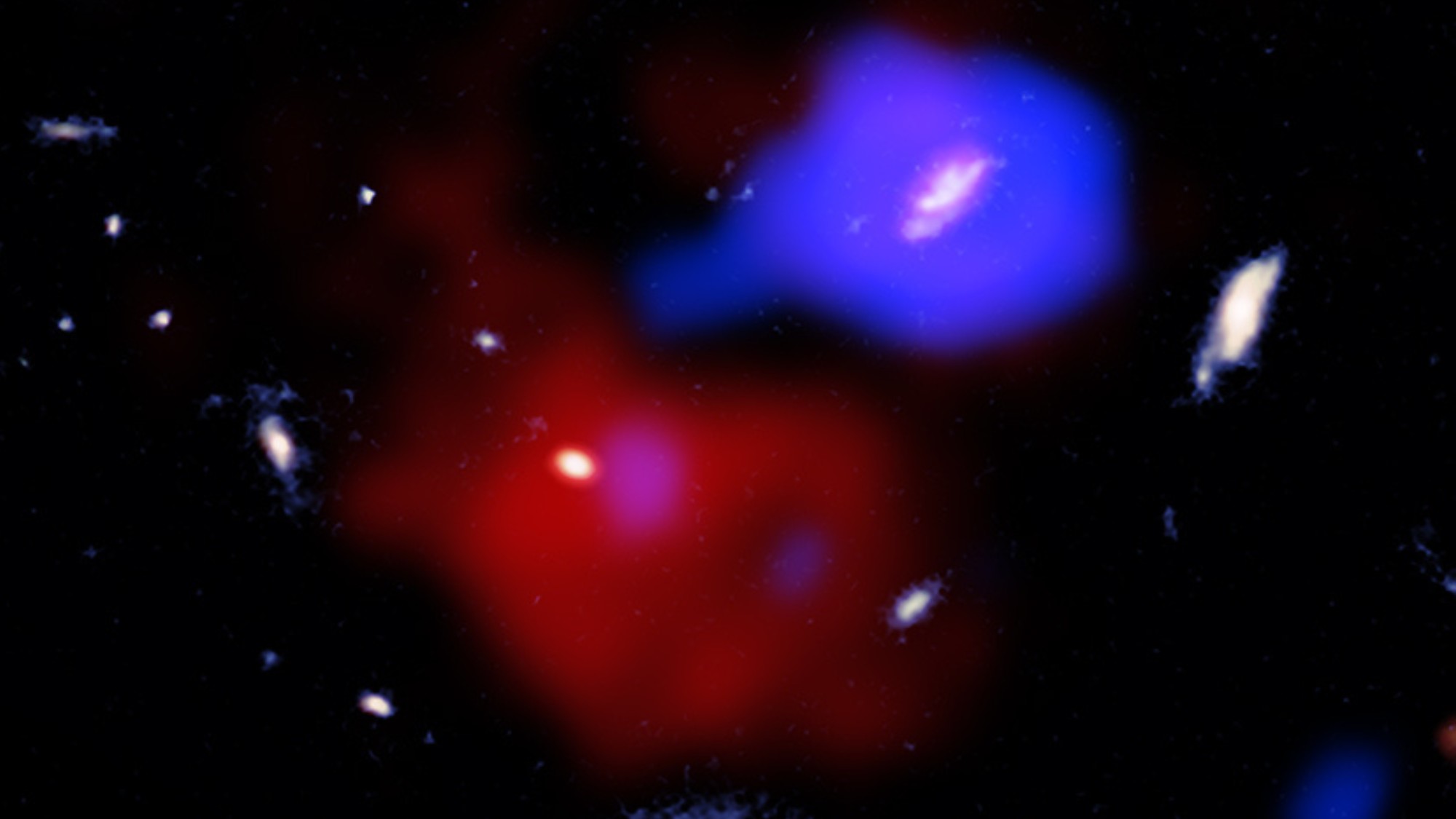
There is a supermassive black hole lurking near a peculiar, potato-shaped galaxy. And it’s cooking.
Well, not literally. But it is stirring up a pot of dense gas until it heats up enough to stop becoming stars.
Using the Chandra X-ray Observatory, astronomers spotted this activity in a galaxy nicknamed the “red potato.” The object sits 11.7 billion lightyears away. It looked like the universe was just 2 billion years old when the light left it. The James Webb Space Telescope originally found it. Its weird, blobby shape got it the nickname. But the real story isn’t the shape. It’s the silence.
Stars should be popping up everywhere in a galaxy surrounded by cold gas. That is how galaxies work. Gas cools. It collapses. Stars form. Repeat.
But the red potato isn’t doing that. It is quiet. Too quiet for what it looks like it should be doing.
So the team looked closer. Specifically, at the X-ray spectrum.
The Turbulent Gas Clue
The first clue wasn’t a spark. It was a mess.
The gas around the red potato is unexpectedly turbulent. Compare that to similar clouds around similar galaxies at that same cosmic epoch, and the difference is stark. This gas is churning. Why?
Wang, the team leader, put it bluntly. If stars aren’t forming like they should, you go looking for the reason. They found a “cook in this cosmic kitchen.”
Not a chef with an apron. A monster.
Chandra Finds the Jet Source
Wang and his colleagues at the University of Milan-Bicocca pointed Chandra at the area. They weren’t just looking for the potato. They were looking for what was bothering it.
They found a supermassive black hole. It is sitting in a nearby galaxy, roughly 200,00 lightyears from the red potato.
That black hole is hungry. Or rather, it is active. It is shooting a jet of material toward the red potato. That jet slams into the ancient gas envelope surrounding the spud-like galaxy.
The result? Chaos.
“If the black hole’s jet is stirring up gas, it could greatly slow down how the galaxy acquires new material,” Sebastiano Cantalupo, a team member, explained. The energy from the stirring heats the gas. Hot gas doesn’t collapse. No collapse means no new stars. The galaxy is being starved of fuel.
A Non-Star-Forming Galaxy in a Star-Burst Region
Here is where it gets interesting.
The red potato is part of a group of galaxies. Most of them are actively forming stars. The black hole causing the trouble is in one of those star-bursting neighbors.
But the red potato itself? It is stuck. It is sitting in its own “pot” of cold, dense gas, watching stars form all around it while it remains stubbornly quiet. This is rare. It is a non-star-forming galaxy in a region defined by star formation.
This discovery provides a concrete look at how neighboring galaxies interact. And often, they interfere with each other.
We usually think of black holes as destroying things. But this shows a more subtle, sustained interference. The black hole isn’t blowing the galaxy up. It’s keeping the kitchen hot enough that no cooking can happen.
Why This Matters for Cosmic Evolution
This isn’t just about a funny-looking galaxy.
It helps explain a specific puzzle in early universe cosmology. Why do some galaxies stop forming stars even when they have plenty of fuel?
The red potato offers a “crumb” of an answer, as team member Andrea Travascio put it. These crumbs lead to bigger questions about galactic evolution.
“The red potato is leaving crumbs of information that might help us track down answers to some really big questions. Quite an important job for a galactic spud.”
The location matters, too. The galaxy sits at an intersection of the cosmic web. It is right where galaxies formed in the early universe. That makes its quiescence even more puzzling. If this region should be bustling with stellar activity, and this specific spot is being muted by a distant black hole jet, it changes how we map cosmic growth.
So, is there a cook?
Yes. But he’s been working for billions of years. And the red potato is slowly baking into nothingness, deprived of the stars it was meant to make.