


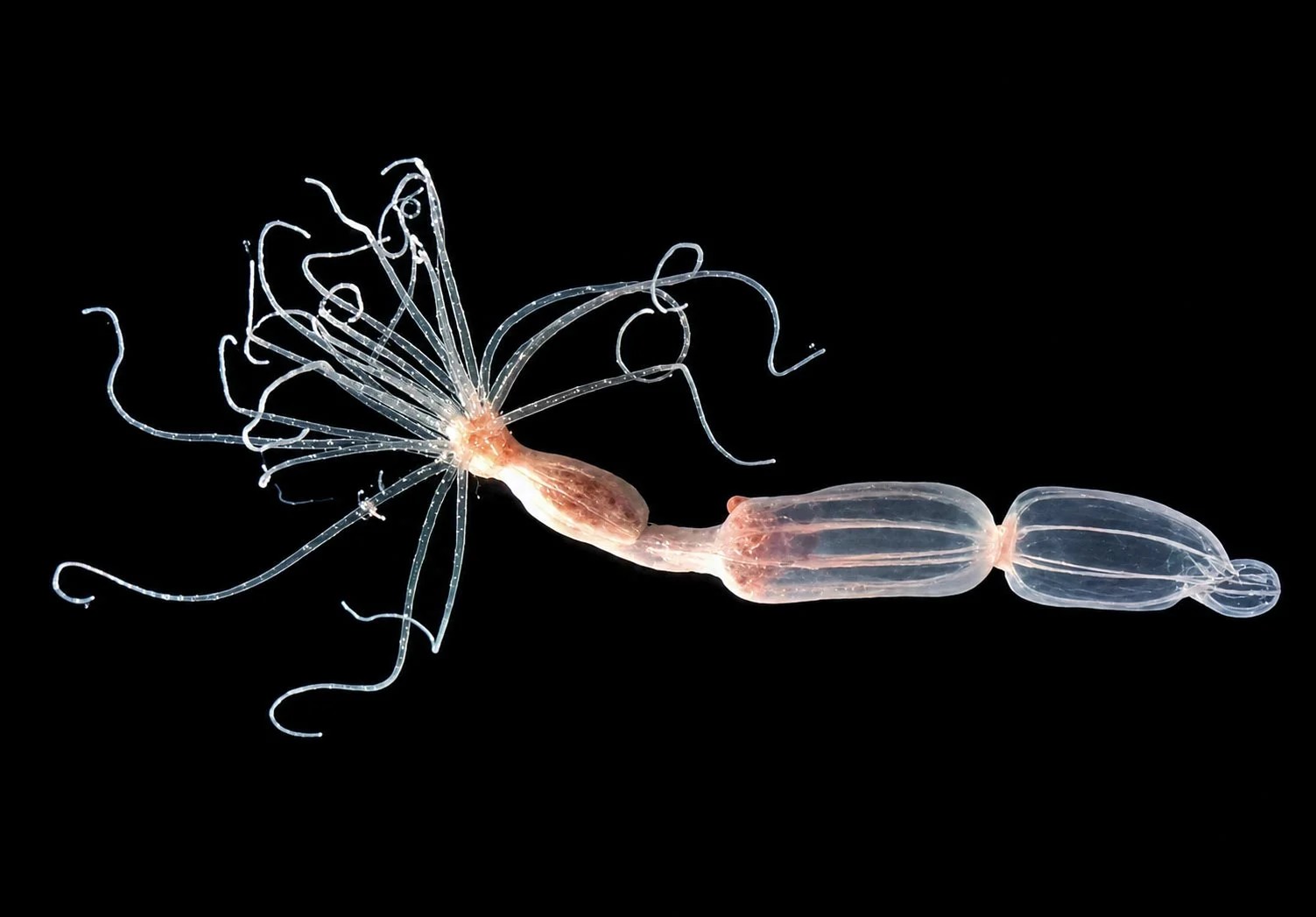
Viruses don’t care about your evolutionary history. They just want to replicate. Humans fight them with MAVS, a protein that acts as a trigger. Sea anemones? They use a nearly identical-looking protein called CARDIB, and it does the exact opposite job. It’s a brake. And without it, the system falls apart.
It turns out, evolution didn’t settle on a single blueprint for immunity.
A Protein That Does the Opposite
Ton Sharoni, PhD candidate at the Hebrew University of Jerusalem, led the study with Prof. Yehu Moran. They were looking at sea anemones because they split from the human lineage over 600 million years ago. If any creature holds the secrets to early animal immunity, it’s the anemone.
The researchers found CARDIB (CARD Inhibitor Binding Protein). At a glance, it mimics MAVS. In vertebrates, MAVS activates immune defenses the moment a virus breaches a cell. It’s an alarm bell.
CARDIB is a muffler.
“Everything about CARDIB suggested it should functionlike MAVS,” Prof. Moran explained. “Instead, we discovered thatit does the exact opposite. Rather than activiting antiviral defenses, CARDIB normally suppresssthem.”
So why keep a brake on an immune system? If you’re slowing down the defense, aren’t you just making it easier for the virus to win? That was the puzzle. And it’s a counterintuitive one.
When You Remove the Brake, the Crash Happens
To test this, the team used CRISPR to edit the anemones. They stripped out CARDIB. Then they hit the edited animals with viruses.
Logic says a suppressed immune system should collapse. But here, removing the suppressor caused the collapse.
Sea anemones lacking CARDIB struggled to control the infection. Viruses reproduced unchecked. The natural antiviral responses didn’t kick in. The animals lost their resistance.
“The results were completely counterintuitive,” said Sharoni. “Although CARDIBacts as a brake on the immune systemunder normal conditions, that brake turnsout to be essential formounting an effective antiviral response.”
You need the restraint to hold the power. Without it, the mechanism jams. Or worse, fails entirely. It’s a fundamental difference from the human model where activation is the key. Here, regulation is the defense.
Nature Doesn’t Care About Lab Results
Lab results can lie. Controlled environments are sterile, predictable, and often misleading. The researchers knew they had to test CARDIB in the wild to see if it mattered.
They moved genetically modified anemones into outdoor mesocosms in South Carolina. Natural estuarine water. Real microorganisms. Actual viral threats. Not petri dishes.
The results held up.
Anemones without CARDIB carried substantially more viral load. One immune gene, seemingly minor in a tank, became critically important in the ocean. The pathway isn’t an artifact of lab conditions. It’s how these animals survive the coastal environment.
“This demonstrated that the pathway wediscovered is not simply a laboratory phenomenon,” said Moran. “Itplays a crucial role inhelping these animals copewith the viral challenges they face in nature.”
Evolution’s Parallel Paths
We often assume biological systems converge. Similar problems yield similar solutions. This study suggests otherwise.
Human immunity and anthozoan immunity are built on fundamentally different logic. Both protect. Both need to detect viruses. But the molecular machinery is inverted. Humans use a system of activation; anemones use a system of controlled suppression.
This has implications for how we study disease. Biomedical research focuses heavily on humans, mice, rats. Familiar models. But ancient lineages like sea anemones may hold evolutionary innovations that remain hidden in our usual subjects.
“Humans and sea anemonesboth need protectionfrom viruses, butthis work shows that evolution can organizethose defenses in fundamentally differentways,” Moran added.
There is no single right way to stop a virus. There are just many ways. And we’re only beginning to see the variety.


