It has been 75 years.
Since 1949, we have identified exactly four new monkey species in Africa. Now. Five.
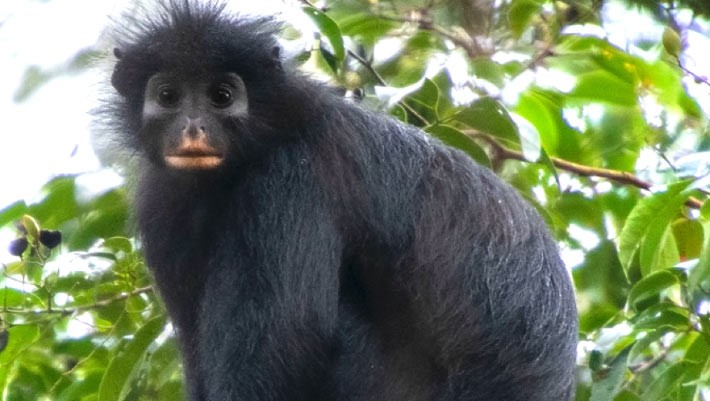
A small, black-furred primate lives in the dense, remote interior of the Democratic Republic Congo. It has a striking face, all black and mask-like, except for an orange-cream patch surrounding the mouth and nose. Near the tail? A prominent white patch.
Scientists call it Colobus congoensis.
Junior Amboko, a PhD student at Florida Atlantic University, led the naming effort. For him, it was personal. A statement of pride in his homeland’s extraordinary biodiversity, so much of it still unseen, unrecorded. He felt honored to honor the Congo Basin itself.
“This discovery highlights… how much remains undocumented,” said Amboko.
We knew it existed earlier than we thought. Back in 2008, researchers photographed these animals in the Lomami Basin. They missed it completely, failing to recognize its significance at the time.
Then. 2018.
A park ranger snapped a photo. Noted the markings. Unusual. Distinct. This sparked real investigation. Rangers followed, documenting sightings repeatedly across the eastern Lomami basin and the adjacent Upper Congo River area. Amboko’s team matched these recent sightings to that decade-old ghost of a photograph.
Here is the odd part. The monkeys live near villages. Local communities? Largely unaware of them. Only 8 out of 52 surveyed villages could describe the monkey. That is a sharp contrast. People there know every other primate in the canopy, yet Congoensis slipped through their cultural radar, almost invisible despite its bright face.
Dr. Kate Detwiler calls this discovery reshaping. Evolutionarily, the implications are massive.
Genetics place Congoensis as closest to the Black Colobus (Colobus satanas ). That is weird. Black Colobuses live over 1,200 kilometers away in west-central Africa. They share mitochondrial DNA that suggests a split roughly 4 to 5 years ago. Deep time.
“Deepest split between sister species,” Detwiler notes, “anywhere in the Colobus genus.”
Even their calls share structures with their distant cousins, though pitch and pattern diverge.
To prove a new species, you need proof. Extensive proof. Christopher Gilbert from CUNY used museum specimens. Skins and skulls from the Yale Peabody, the American Museum of Natural history, vast comparative datasets. The evidence was conclusive, rapid confirmation from a robust pool of physical facts.
Julia Arenson from Yale compared the anatomy.
“Unique,” she said. “Shares features… to the exclusion of others.”
The range is tiny. Field surveys from 2018 to 2022 found just 114 sightings. The entire estimated territory? Roughly 1,700 square kilometers.
Other Colobus monkeys roam ranges exceeding 60,00 square kilometers. This population lives in small groups, averaging six individuals. Often mixed in the canopy with other species, blending, traveling together.
Scientists propose an Endangered status. The area is too small, the population too precarious.
Dr. John Hart from the Lukuru Wildlife Research Foundation reminds us. The Congo Basin remains a frontier. Mammals hide there, even in scientifically explored regions, waiting for us to look. Really look.
The paper is published in PLOS ONE. Hart and colleagues titled it Likweli. The name lingers in the air.